-
 Pickets Supporting Housing Ordinance Tell Why They March
-
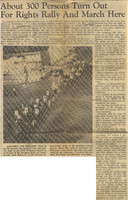 About 300 Persons Turn Out For Rights Rally And March Here
 This newspaper clipping describes a Freedom Rally sponsored by the Student Non-Violent Co-Ordinating Committee (SNCC) of over 300 community members marching from City Hall to the First Method Church near the University of Michigan’s Central Campus. This event, which featured John Lewis, was to precipitate the March on Washington for Jobs and Freedom that would take place the following day in Washington D.C.. At the start of the event, the SNCC was joined by demonstrators of the Ann Arbor Fair Housing Association - CORE who were continuing their advocacy for fair housing.
-
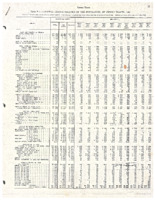 Excerpts from the 1960 Census of Ann Arbor
 These two sheets of data were compiled during the 1960 Census and reflect population statistics for the city of Ann Arbor and the greater Washtenaw County. While Census data often fails Black and Brown people, it is critical to note how almost 40% of the recorded Black population of Ann Arbor was noted to live within Census Tract WA-0007, which roughly corresponds to the North Central and Northeastern areas of the city. Moreover, much can be gleaned from looking at the non-white populations and class dynamics of surrounding tracts to understand the shape of segregation in the city and county.
-
 Letter from Harriet Fusfeld
 Directed towards the Human Relations Commission of Ann Arbor, this letter describes a variety of ongoing tacit policies creating barriers to fair housing in the city. Of importance is an anecdote on page 2 about a local landlord who constructed apartments out of various homes in Ann Arbor - all of which he neglected to service while keeping rent high (see “Related Item(s)” for more). Fusfeld notes that local organizations, such as the NAACP, were planning to work on or grow outreach efforts to residents to ensure their rights remained respected and protected.
-
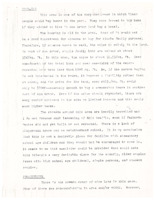 Unnamed Land Assessment Study of North Central Ann Arbor
 This unidentified land assessment of the North Central area of Ann Arbor provides context for the historical settlement of the region by Black residents, while providing ideas for its potential redevelopment. The focus on specific plots along North 4th Avenue connects with other materials from the period (see “Related Item(s)”) that recognize the street as a site of heavily contested meaning for the predominantly Black residents living there and increasingly encroaching forces looking to make a profit from the neighborhood.
-
 North Central Area Study -- Limited to Beakes, Depot, Main triangle
 This report was made by Eunice Burns, a then member of the Ann Arbor Planning Commission, to look into the potential city purchase of various plots of land from a developer in the North Central area of the city (Michigan Historical Collections staff, n.d.). Given the context of purchase dates and areas, this seller is most likely the landlord who purchased a variety of units in the Beakes, Depot, Main triangle during the early 1960s (see “Related Item(s)”). Of note is that this item directly cites a report from Harriet Fusfeld to the Human Rights Commission several years earlier (see “Related Item(s)”).
-
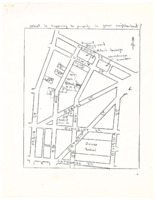 "What is happening to property in your neighborhood?” Flyer
 This flyer from the Human Relations Commission warns Ann Arbor residents about multiple schemes designed to push residents to sell their properties and offers resources for getting accurate financial advice. One ploy mentioned involved a local landlord who was increasingly buying houses in the North Central Area, an act of gentrification which began changing the value of homes in the neighborhood (see “Related Item(s)” for more).
-
 [Untitled]
-
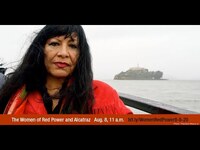 Presentation: Indigenous Women of Alcatraz and the Red Power Movement
 Women played a key role in organizing and maintaining the occupation of Alcatraz Island (1969-1971) yet their story is often overlooked. This panel, moderated by original occupier Dr. La Nada War Jack, explores the role of women in the indigenous rights movement from the occupation to the present. Please join us to hear the stories of these remarkable women who continue the hard work of positive change.
Dr. LaNada War Jack is a member of the Shoshone-Bannock Tribes where she lives on the Fort Hall Indian Reservation in Idaho. In January of 1968 she was the first Native American student enrolled at the University of California at Berkeley and graduated with honors in an Independent Major of Native American Law & Politics. While attending UC Berkeley, Dr. War Jack participated as the first Native American component of the first Ethnic Studies Program in the UC statewide effort in establishing Native American Studies, African American Studies, Chicano Studies and Asian Studies. She is the author of Native Resistance An Intergenerational Fight for Survival and Life.
-
 You Are On Indian Land
 Three girls stand next to the messaging of the occupation found on Alcatraz Island during the Occupation of Alcatraz by Native activists
-
 Herb Dittersdorf Portrait for Bio.
-
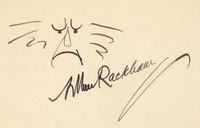 Arthur Rackham Signature
-
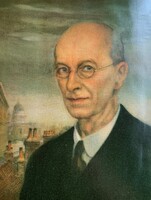 A Transpontine Cockney: Self Portrait by Arthur Rackham (1867-1939)
 This is a replication of a self portrait that Arthur Rackham painted of himself using oils on canvas. It is found in the cover page spread of "Arthur Rackham: His Life and Work" by Derek Hudson (1975).
-
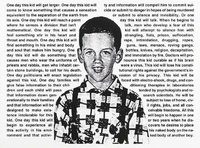 Untitled (One Day This Kid...)
 This photo-text collage shows the artist as an elementary school child, with the surrounding text describing possible violence and discrimination he may encounter as a gay man.
-
 Triptych August 1972
 An abstract portrait of George Dyer (left panel), Francis Bacon (right panel) and their coupling (central panel), set against black voids
-
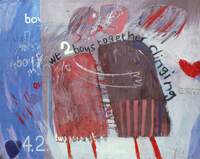 We Two Boys Together Clinging
 An abstract oil painting on board of two men kissing in front of a lavatory wall covered in graffiti
-
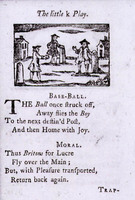 Page from John Newberry's "A Pretty Little Pocket Book."
 VOCAB
-
Testing
-
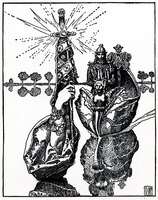 Excalibur and the Sword
 This is an illustration by Howard Pyle for the 1903 book "The Story of King Arthur and His Knights". It depicts the sword in the stone.
-
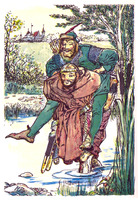 Robin Hood and Friar Tuck
 This is a Howard Pyle illustration from the 1883 edition of "The Merry Adventures of Robin Hood".
-
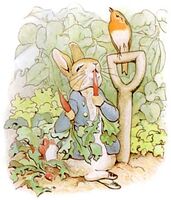 Peter Rabbit
 This is an illustration from Beatrix Potter's 1902 book "The Tale of Peter Rabbit". It depicts Peter Rabbit eating Mr McGregor's vegetables.
-
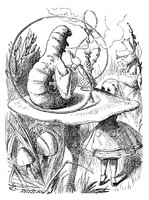 Alice and the Caterpillar
 This is a John Tenniel illustration from the 1865 edition of Alice's Adventure in Wonderland. It depicts the Caterpillar and Alice conversing.
-
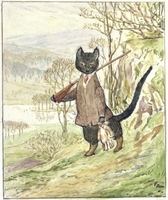 Kitty in Boots
 This is an illustration from an early Beatrix Potter book called "Kitty in Boots".
-
 Johnson & Graham's Lessee v. McIntosh, 21 U.S. 543 (1823)
 Land transfers from Native Americans to private individuals are void. When a tract of land has been acquired through conquest, and the property of most people who live there arise from the conquest, the people who have been conquered have a right to live on the land but cannot transfer title to the land.
Facts
This action for ejectment was based on a land dispute after Thomas Johnson, a Supreme Court Justice, bought land from Native Americans in the Piankeshaw tribe. His descendants inherited the land after Johnson's death and leased it to individuals who brought the action against William M'Intosh. The federal government had given M'Intosh a land patent to allegedly the same land, although in reality it appears that the properties were actually separate. The parties thus brought this litigation in order to obtain a judgment on priority rights to property more generally.
Ruling that the Native American tribe did not have the right to convey the land, the federal district court held that Johnson's initial purchase and the chain of title stemming from it were invalid.
Note: Marshall's reliance on international law as basis for discovery doctrine.
Opinions
Majority
John Marshall
Bushrod Washington
Henry Brockholst Livingston
William Johnson, Jr.
Thomas Todd
Gabriel Duvall
Joseph Story
In an unanimous opinion, Marshall used historical analysis to find that only the government, rather than the Native American tribes, held title to the the land. He argued that the patterns of discovery during the European colonization of the New World meant that each European nation gained sovereignty (and also title) over the land that it discovered. This trumped the right of occupancy of the Native American tribes, at least with regard to the specific colonizing power. In the situation of the U.S., this right belonged to the British when they first acquired colonies. The federal government then inherited the right from Great Britain after the American Revolution. Native Americans cannot sell their land except to the federal government.
Case Commentary
This case created a distinction between the right of occupancy and the right of ownership that persists in U.S. jurisprudence concerning Native American lands. Economists have pointed out that limiting the right to purchase Native American land to the federal government allows it to be sold at the lowest possible prices because there is no competition. The patronizing tone of the opinion has fallen into disfavor as Native Americans have come to receive more sympathy from the legal academy, but its holding remains valid.
* Annotation taken from Justia.com
-
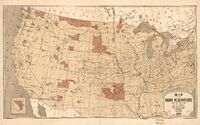 Map showing Indian reservations with the limits of the United States : 1883
 Map showing Indian reservations with the limits of the United States : 1883