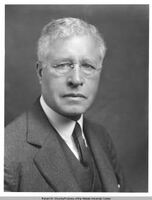
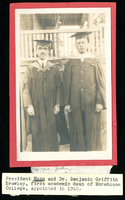
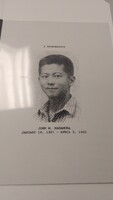
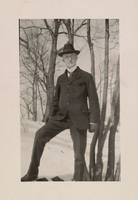
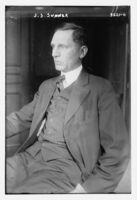
Portrait of Dr. John Hope, the first African-American president of both Atlanta University and Morehouse College. In 1906, he succeeded Dr. George Sale as president of Atlanta Baptist College. On July 1, 1929, he succeeded Mr. Myron Adams as president of Atlanta University. He died February 20, 1936 in Atlanta.
Land transfers from Native Americans to private individuals are void. When a tract of land has been acquired through conquest, and the property of most people who live there arise from the conquest, the people who have been conquered have a right to live on the land but cannot transfer title to the land.
Facts
This action for ejectment was based on a land dispute after Thomas Johnson, a Supreme Court Justice, bought land from Native Americans in the Piankeshaw tribe. His descendants inherited the land after Johnson's death and leased it to individuals who brought the action against William M'Intosh. The federal government had given M'Intosh a land patent to allegedly the same land, although in reality it appears that the properties were actually separate. The parties thus brought this litigation in order to obtain a judgment on priority rights to property more generally.
Ruling that the Native American tribe did not have the right to convey the land, the federal district court held that Johnson's initial purchase and the chain of title stemming from it were invalid.
Note: Marshall's reliance on international law as basis for discovery doctrine.
Opinions
Majority
John Marshall
Bushrod Washington
Henry Brockholst Livingston
William Johnson, Jr.
Thomas Todd
Gabriel Duvall
Joseph Story
In an unanimous opinion, Marshall used historical analysis to find that only the government, rather than the Native American tribes, held title to the the land. He argued that the patterns of discovery during the European colonization of the New World meant that each European nation gained sovereignty (and also title) over the land that it discovered. This trumped the right of occupancy of the Native American tribes, at least with regard to the specific colonizing power. In the situation of the U.S., this right belonged to the British when they first acquired colonies. The federal government then inherited the right from Great Britain after the American Revolution. Native Americans cannot sell their land except to the federal government.
Case Commentary
This case created a distinction between the right of occupancy and the right of ownership that persists in U.S. jurisprudence concerning Native American lands. Economists have pointed out that limiting the right to purchase Native American land to the federal government allows it to be sold at the lowest possible prices because there is no competition. The patronizing tone of the opinion has fallen into disfavor as Native Americans have come to receive more sympathy from the legal academy, but its holding remains valid.
* Annotation taken from Justia.com
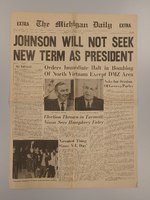
The front page of The Michigan Daily's extra issue for April 1, 1968, states in a large headline that President Lyndon Baines Johnson will not seek a second term as President of the United States. Next to a photo of President Johnson is a photo of Senator Eugene J. McCarthy from Minnesota, who ran for the Democratic nomination on an antiwar platform in 1968 and won popularity on many college campuses. The bottom left corner of the front page includes a photograph of University of Michigan students celebrating President Johnson's announcement on the Diag.
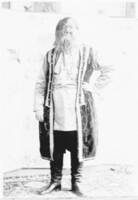
This black and white photograph is somewhat overexposed but still portrays Fedor Jeftichew, also known as Jo Jo. Standing straight forward with his hand on his hip, his eyes look straight at the camera through his face covered in hair.
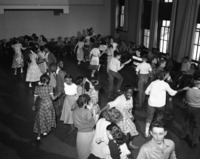
This photograph depicts a racially-integrated school dance for students attending the Jones School in 1949. During this era, the school was involved in early attempts to integrate primary education by offering busing for white students from towns just north of Washtenaw county (Jones School, n.d.) (Monagan, 2019).
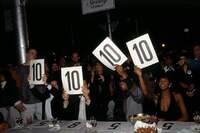
Generous scoring by the judges at the Tanqueray Ball Aids Benefit, 1990. Those who walk the balls are judged on their outfits, poise, dances and attitude
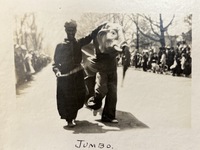
One of several blackface performances in the Union Circus, "Jumbo" the elephant and his guide drew much attention from the watching crowds. In place of real exotic animals, students dressed in animal costumes. The elephant, dubbed "Jumbo" by the inscription, required two students to act as legs. The white man guiding Jumbo wears a turban and blackface.
The phrase "All Together Julia-" is inscribed under the second image in the Low scrapbook.
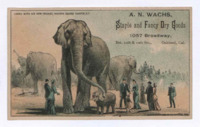
An advertisement for Staple and Fancy Dry Goods featuring the new attraction to Madison Square Garden, Jumbo. Jumbo was a large African bush elephant that had been recently brought over from London by P.T. Barnum who claimed Jumbo was the "largest elephant in the world." Jumbo would eventually die in in 1885 after being hit by a train.
This fresco depicts the Roman god Jupiter kissing his mortal lover Ganymede. Painted as an imitation of an ancient Roman fresco, it was created to fool archeologist and art historian Johann Joachim Winckelmann, due to his enthusiasm for homosexual love and themes.
Damiano Kafero (plaintiff) sued 1. Mesusera Muwawa, 2. Feridinado Kalengezi, 3. Kaloli Kinya, 4. Gonsiyano Wambere and 5. Akirewo Mugandasibirwa (defendants)for harvesting food from his garden without paying land rent. The accused had been allowed to use the land by Kafero's father. But when his father died, Kafero became the principal heir and decided to evict them claiming they did not pay rent. The appeal was dismissed because, in the circumstance, the court felt it unfair to evict the accused.
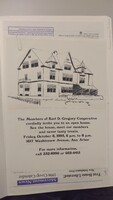
A flyer for an open house commemorating the opening of the Karl D. Gregory Cooperative. Gregory is noteworthy for being the only explicitly substance free co-op in the ICC