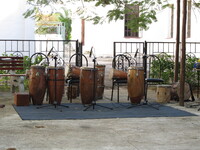
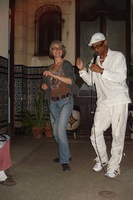
Folkloric shows are created around the music of many different styles of Afrocuban religious and popular traditions. The basic ensemble consists of three conga drums (tumbadoras), a pair of claves, and a wood block (or bamboo). There are also sets of drums that are specific to particular types of music such as the batá drums of Regla de Ocha (Santeria) or the biankomo of Abakuá folklore. In the past decades the tradition of rumba has expanded musically and most groups that play rumba supplement the basic ensemble with other drums. Here you see cajaones supplementing the use of tumbadoras.
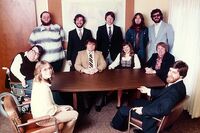
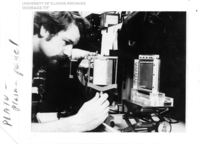
Photograph of staff at Duosoft, an Urbana-Champaign based hardware and software start-up that developed and programmed PLATO courseware for Control Data Corporation from 1981-1985. Seated at the far left is Duosoft owner and programmer Gary Michael.
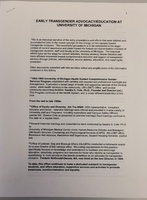
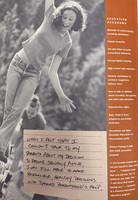
An historical narrative documenting early transgender advocacy efforts by the University of Michigan. It presents transgender advocacy as a work in progress and lists areas the University has already made progress in.
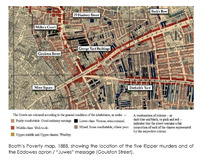
A cropped part of Charles Booth's 1888 Poverty Map featuring the Whitechapel district of London and marked with locations where Ripper victims were murdered or case evidence was discovered.
Named after the Palestinian-American professor, the Edward Said Multicultural Lounge hosts a library dedicated to Arab and Arab-American works by various authors. The library acts as a source for both historical and modern critical essays and fiction, and aims to empower Arab and Arab-American students and visitors at the University of Michigan. This library was selected for the archive as it is one of the last remaining multicultural lounge libraries accessible on the University of Michigan's campus, as well as the various resources offered through the Arab Student Organization, who host meetings within the main lounge. The library is open seven days a week, from 10am to 12am, to students living in the University of Michigan's North Quadrangle, as well as visitors who are approved by staff beforehand. Items cannot, however, be removed from the lounge. The lounge is located on the first floor of the North Quadrangle, the address of which is 105 S State St, Ann Arbor, MI 48109.
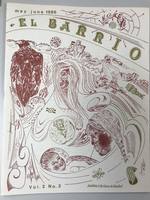
El Barrio is a bimonthly publication of Casa De Unidad and features community profiles and events in Detroit, MI.
Page 5 features Lupe Lozano via a profile written by her daughter Maria Theresa Rodriguez. Lupe arrived to Detroit from Aguascalientes, Mexico in 1923.
On page 13, "Personas del Barrio or Barrio People", local musician Benny Cruz is featured. His band "La Buena Vida" was formed in 1977 and played at weddings, quinceañera covers of Latino favorites such as Los Tigres del Norte or el Trio Los Panchos.
Page 14-15 showcases community events in early May 1986.
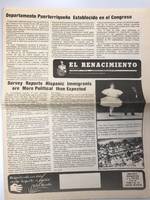
A monthly Spanish language newspaper for Lansing's Latinx community. Frontpage articles are in English and Spanish.
A monthly Spanish language newspaper for Lansing's Latinx community. Front page articles are in English and Spanish. This page titled "El Mercadito de Lansing" features ads of Latino small businesses in Lansing.
Page 8-9 features El Renacimiento's fundraising efforts on September 3, 1989 to keep the newspaper running.
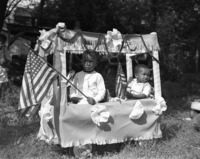
This is a photograph of nursery school students Eldridge & Zonnechris Askew at a Bethel A.M.E. community event (Eldridge & Zonnechris Askew In The Bethel A.M.E. Nursery School Parade, August 1949, n.d.). Bethel A.M.E. was a stronghold of community gathering and action in the Black community of Ann Arbor's North Central area (Shackman, 2000).
This letter was written by Eleanor Roosevelt to Lorena Hickok. The correspondence took place just days after the death of President FDR, Eleanor's husband. In the letter, she grieves for him and speaks about her idea of what life will be like moving forward without him.
In this letter, Eleanor Roosevelt complains to Lorena Hickok about her time in Australia. She is there to provide aid to the Australian troops during the war (WWII).
Bumper sticker of Vicki Jimenez running for Lansing School Board. This promotion material is indicative of multiple generation presence of Latinx in Michigan, where community has enough political power to participate in local elections and education.
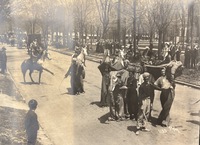
Taken from the Kapp scrapbook, this image is inscribed with "Lyndon. 1133" and captioned with sentence "Elephants at 'Parade Rest'". It depicts the Union Circus parade, temporarily paused next to the university campus. White students clad in blackface perform various roles as either elephant trainer or indigenous person. Their costumes depict stereotypes of native peoples and of South Asians. Circus goers watch with interest from the sidelines. The Ann Arbor trolly tracks can be seen along the grass.
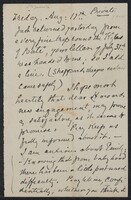
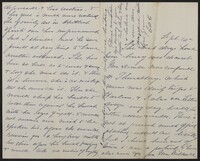
A short note from Dr. Elizabeth Blackwell to her brother Howard Blackwell. Dr. Blackwell is worried about their sister Dr. Emily Blackwell's health, and speculates about the nature of her relationship with her partner Dr. Elizabeth Cushier.
Letter from Dr. Elizabeth Cushier to her partner, Dr. Emily Blackwell. Dr. Cushier discusses several patients she has seen, her struggles with home improvement work being done on their house, and expresses her excitement that her "own dear doctor" will soon be home.