Search
1896 items
-

Colney Hatch Lunatic Asylum
The mental institution where Jack the Ripper Suspect Aaron Kosminski was an inmate from 1891 to 1894 -

Color Illustration in "The Lonesomest Doll"
This is a color illustration done by Arthur Rackham for the 1928 illustration version of "The Lonesomest Doll" (1901) by Abbie Farwell Brown. It depicts the female main character at a fountain. -

Color Photos of Visitors at Lava Point Overlook
A color photo of a young woman smiling near Lava Point Overlook at Zion National Park -
-
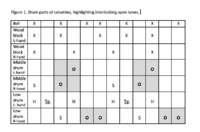
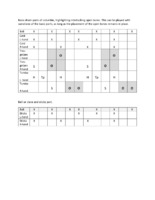
Columbia rhythms
transcription of percussion rhythms -

-

Come Into My House
Come Into My House featuring Willi Ninja and vogue dancers -

-

Community Support
Quote from a Planned Parenthood of Mid-Michigan patient named Julie from Ann Arbor, MI who talks about the importance of volunteering and donating to PP. -

Complex Rhythms
Poster for "Complex Rhythms" -
Concord Grape Wine I & II
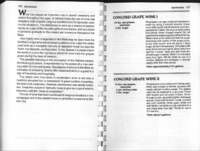
Wine has played an important role in Jewish ceremony and culture throughout the ages. In biblical times the use of wine was obligatory both in public religious functions and for domestic ceremonial occasions. The references to wine as a means of promoting joy, as a sign of the bountiful gifts of providence, and as a token of personal gratitude to the creator are numerous throughout the Bible. How highly wine is regarded in the Bible may be seen from the fact that in a figurative sense Israel is called a vine. Later the rabbis used wine as a metaphor not only to represent Israel but also the Torah, the Messiah, and holy men. In the Talmud it is stated that in the world to come the righteous will drink wine from the grapes grown during the days of creation. The greatest blessing in the conception of the Hebrew people, the blessing of peace, is represented by the picture of a man resting under his vine and fig tree. Abundance of wine is in the Bible an indication of prosperity, and to offer bread and wine to a guest is a sign of friendship and hospitality. The rabbis held that taken in moderation wine is not only a healthful stimulant but is possessed of great curative properties, the best of all medicines. However, drunkeness was strictly forbidden. It was the custom in Talmudic times to give ten cups of wine to mourners with the "meal of consolation". The use of wine has been continued at religious functions in the synagogue and in the Jewish home on all festive occasions to this very day. Concord Grape Wine I 10 lbs. ripe grapes, stemmed 5 lbs. sugar Put grapes in an open crock and squeeze or mash by using 2 smooth boards. Cover crock with muslin and let stand at room temperature for 1 week. Stir once or twice during that period. Strain through muslin. Do not squeeze the mashed grapes while straining. Return the wine to the crock and add the sugar, dissolved with some of the grape juice. Cover with muslin and let stand 7 days longer at room temperature. Fill bottles with wine, but do not cork tightly. Store in a cool place away from light for 1 month. Taste and add more dissolved sugar if desired. Will be ready for use in 3 months. Matures and increases in strength after that initial period. Yield: approximately 2-2 1/2 gallons Concord Grape Wine II 10 lbs. ripe grapes, stemmed 3 qts. boiling water 5 lbs. sugar Put grapes in crock and pour in boiling water. When cool enough to handle, squeeze with hands without crushing seeds. The grapes need to be mashed to a dry pulp. Cover with muslin and let stand 3 days. Strain through muslin, squeezing lightly. Add sugar and stir. Cover and let stand 1 week. Uncover and skim carefully. Lay bottle on side and store in a cool place away from light. Ready for use in 2-3 months. Yield: about 2 gallons -
Confirmations, 1986 - 1992
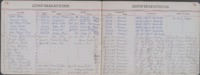
Pages from Church of the Ascension record book of confirmation ceremonies conducted from 1986 - 1992. The names of the confirmation recipients is indicative of the shifting demographic of the church from being majority Caucasian to Latino, and the various countries they may have been born or received Baptism in. -

Connie Flemming poses on the runway of Mugler's fashion show
Connie Flemming poses on the runway of Thierry Mugler's fashion show in 1992 -
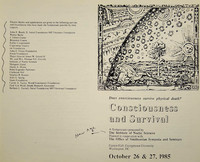
Consciousness and Survival
A pamphlet for the symposium 'Consciousness and Survival' -

Conservation Clout: Environmental units merge
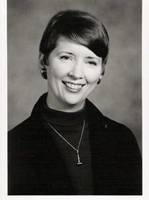
Newspaper article with a picture of Ken Sikkema discussing the formation of the Michigan Environmental Council -
-

Control Data Corporation's 'Homework' and Selective Placement Programs, from Managing and Employing the Handicapped: The Untapped Potential (1981)
A report from 1981 on industry programs for employing handicapped persons. The section on Control Data Corporation reads: "HOMEWORK" Another Midwestern giant corporation (3M is headquartered in St. Paul; Control Data's home is in Minneapolis) has put its own technology to good use for itself and its disabled employees. Control Data has a developed a program called "Homework" for severely disabled homebound employees. Homework is designed to provide, first, training and, then, employment through the technology at the PLATO system. PLATO is a computer-based educational system that utilizes a computer screen and keyboard. A PLATO terminal can be installed in anyone's home and linked to terminals at the office, or nearly any other location. The project began in 1978 with 12 trainees who were disabled employees of the corporation. Each had a terminal installed in his or her home. For a year they were trained to become PLATO courseware writers. The trainees proved the success of the venture by writing a course that teaches programmers how to write in Pascal, a computer language. Control Data was sufficiently pleased with the initial project to begin two more: one will train 14 disabled employees to be business application programmers; the second will teach other disabled workers to become tutors in the rather extensive Control Data Institute (CDI) educational program, which also uses the PLATO system. Thus, CDI tutors (like Carol Anderson, an original course-writer trainee) can still remain at home and provide instant feedback to students via their terminals in an instruction center. William Norris, chairman and chief executive officer of Control Data, believes the Homework concept has a significant future. He points out that "there are more than two million Americans classified as being homebound because of a severe mental and/or physical disability." Further, Norris envisions that the Homework and programs like it "will become an employment alternative, not only for the disabled population, but also the able-bodied." Control Data's involvement in social issues—including seeking employment outlets for the disabled—stems from a point of view that might also be of general interest. Again, we quote William Norris: The time is long overdue when business should take the initiative, in conjunction with government and other sectors of society, in addressing these problems as profitable business opportunities, with an appropriate sharing of costs between the private sector and government. SELECTIVE PLACEMENT Since 1975 Control Data has employed a rehabilitation counselor, much in the mold of Paul Ashton of 3M. Again, the purpose is to rehabilitate and selectively place disabled employees in suitable jobs. The objectives are to not waste human resources, to maintain productivity, and to save on disability payments. (To that last objective, Control Data estimates that its rehabilitation program has saved several hundred thousand dollars.) Stephen Wastvedt, of the personnel office of Control Data, has provided us with two examples of their selective placement pro- gram. The first is an epileptic applicant, whose medication slowed his mental faculties somewhat. Recognizing that his slowness did not negate his basic reliability and competence, the corporation found him a job he could handle—cleaning computer tapes. Since then he has been promoted to process control aid and is doing well. The second case involves an applicant who was close to a degree in computer science and who had cerebral palsy. Mr. Wastvedt was able to find the applicant an internship, so that he could finish his degree. He became a permanent employee (computer program- mer) when Wastvedt was able to locate a position that did not put excessive demands upon the employee's limited communication abilities. The placement is considered a success by both employee and corporation. -
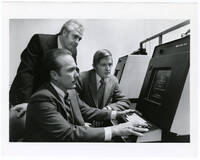
Control Data executive meeting with Minnesota Commissioner of Corrections at PLATO terminal in Stillwater Prison.
Photograph of Control Data executive meeting with Minnesota Commissioner of Corrections at PLATO terminal in Stillwater Prison. From source description: "Eugene L. Baker, VP Human Resource Management CDC; Kenneth E. Schoen, Commissioner of Corrections State of Minnesota (seated); Frank Wood, Warden (standing). Real/Time 1976 Volume 13 #4." -
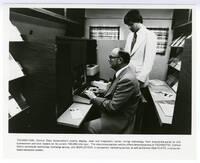
Control Data's Techno-Van
Photograph of the inside of Control Data's Techno-Van. The caption reads: "TECHNO-VAN, Control Data Corporation's mobile display, sales and hospitality center, brings technology from around the world to U.S. businessmen and civic leaders on its current 100,000-mile tour. The electronics-packed vehicle offers demonstrations of TECHNOTEC, Control Data's worldwide technology exchange service, and WORLDTECH, a companion marketing service, as well as Control Data PLATO, a computer-based education system." -

Cooking Marshmallows at the Canyon Campground
Two people cook marshmallows over a fire at Yellowstone's Canyon Campground. -

Cooperator Article About Black Elk / Luther
Letter detailing the opening of two new ICC coops: Black Elk and Luther -
Cooperator Article about Creation of North Campus Housing
Description of ICC plan to expand into North Campus -

Corn Hole -- Ladies' Hour, Hot Springs National Park.
Women in dresses soak their feet in a hot spring. -
-
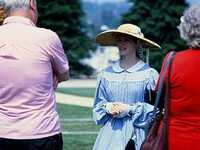
Costumed interpreter at Gettysburg National Military Park.
A costumed interpreter speaks to visitors at Gettysburg National Military Park.