-
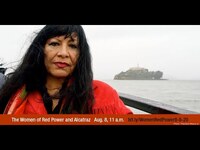 Presentation: Indigenous Women of Alcatraz and the Red Power Movement
Women played a key role in organizing and maintaining the occupation of Alcatraz Island (1969-1971) yet their story is often overlooked. This panel, moderated by original occupier Dr. La Nada War Jack, explores the role of women in the indigenous rights movement from the occupation to the present. Please join us to hear the stories of these remarkable women who continue the hard work of positive change.
Dr. LaNada War Jack is a member of the Shoshone-Bannock Tribes where she lives on the Fort Hall Indian Reservation in Idaho. In January of 1968 she was the first Native American student enrolled at the University of California at Berkeley and graduated with honors in an Independent Major of Native American Law & Politics. While attending UC Berkeley, Dr. War Jack participated as the first Native American component of the first Ethnic Studies Program in the UC statewide effort in establishing Native American Studies, African American Studies, Chicano Studies and Asian Studies. She is the author of Native Resistance An Intergenerational Fight for Survival and Life.
-
 You Are On Indian Land
Three girls stand next to the messaging of the occupation found on Alcatraz Island during the Occupation of Alcatraz by Native activists
-
 Native American Maggie
-
 Close up of Maggie peeking out of unfinished chucka.
-
 Maggie Howard cooking back of Museum.
-
 Ta-buce out gathering acorns and grass seeds, Ahwahnee Mdw. 1930's
-
 Ta-buce (Maggie Howard) among oaks picking acorns.
-
 Ta-buce, or Maggie Howard, out after acorns
-
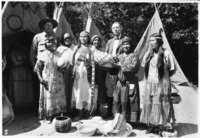 Indian Field Days
Content Note: Indian Field Days, while an important place for basket weavers like Tabuce Howard to sell and market their work, were a series of events that subjected local indigenous populations to discrimination and stereotyping. Native peoples in the area were paid to wear costumes belonging to Plains Indians and stand by fabricated "wig wams" for the benefit of white tourists. Because of the often untruthful depictions of local indigenous peoples in the images from these events, we have largely left them out of our archive. This image is the exception as it does present an important role in the lives of female basket weavers like Tabuce Howard, Lucy Telles, and Carrie Bethel.
-
 Basket by Tabuce Howard
Coiled. Willow, sedgeroot, redbud, bracken fern root. H 17, Dia 36 cm
Yosemite National Park, YOSE 66801
-
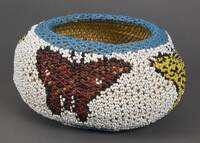 Basket by Tabuce Howard
Unlike other weavers who created their patterns by counting out beads as they wove, Maggie Howard would sometimes bead directly onto a pattern to avoid having to count beads. Maggie stitched the pattern to this basket and then beaded over it.
Coiled. Glass seed bead, willow, paper, thread. H 9, Dia. 16.2 cm
Yosemite National Park, YOSE 7223
-
 Basket by Tabuce Howard
This basket is one of several Maggie Howard made incorporating her Paiute name "Tabuce" as the pattern.
Coiled. Willow, bracken fern root, redbud. H 7.5, Dia 15.2 cm
Yosemite National Park, YOSE 7863
-
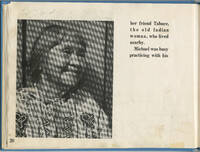 Michael and Anne in the Yosemite Valley
Children's book describing Michael Adams and Anne Adams Helms adventures in the High Sierras illustrated with photographs by Ansel Adams. Story follows the daily life and customs of brother and sister living in the Yosemite Valley exploring nature, visiting with Maggie ""Tabuce"" Howard (a major basket demonstrator and member of the Mono Lake Paiute tribe), and spending time with their Uncle Don.
-
 Maggie Howard--Mono Lake Paiute--ca 1930's at Yosemite
Yosemite Maggie Howard--Mono Lake Paiute--ca 1930's at Yosemite Photograph Notes: Maggie Howard--Ta-bu-ce--Mono Lake Paiute--ca 1930's--Yosemite Valley Indian Day Indian Photograph Source
-
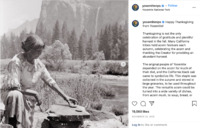 A Thanksgiving Instagram post featuring Maggie Tabuce Howard
Caption reads:
"Happy Thanksgiving from Yosemite!
Thanksgiving is not the only celebration of gratitude and plentiful harvest in the fall. Many California tribes hold acorn festivals each autumn, celebrating the acorn and thanking the Creator for providing an abundant harvest.
The original people of Yosemite depended on the acorn for much of their diet, and the California black oak came to symbolize life. This staple was collected in the autumn and stored in large granaries, to be used throughout the year. The versatile acorn could be turned into a wide variety of dishes, from acorn mush, to soup, bread, or cakes.
Tabuce (“Maggie”) Howard (1870-1947) was a Paiute woman who was born at Mono Lake but moved to Yosemite Valley at a young age. At first, she made her livelihood working in park hotels, and later by making baskets to sell to tourists. Most importantly, she also gave public presentations where she demonstrated traditional crafts and cooking techniques. Photos show her processing and pounding acorns, then cooking acorn cakes on a heated stone.
November is National Native American Heritage Month, and Yosemite is the ancestral home of seven traditionally associated tribes: the American Indian Council of Mariposa County, Inc. (aka Southern Sierra Miwuk Nation), Bishop Paiute Tribe, Bridgeport Indian Colony, Mono Lake Kutzadikaa, North Fork Rancheria of Mono Indians of California, Picayune Rancheria of the Chukchansi Indians, and the Tuolumne Band of Me-Wuk Indians. Learn more about Yosemite's original people on the park website (link in our profile.) #NAHeritage #Yosemite #nationalpark"
-
 Bread From Acorns
A video of Maggie Tabuce Howard demonstrating how Native Americans used acorns to make bread.
-
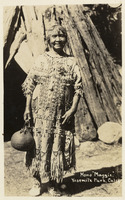 Mono "Maggie", Yosemite Park, Calif.
View of the Paiute woman Tabuce, also known as Maggie Howard, in Yosemite in native dress. A bark house is seen behind her.
-
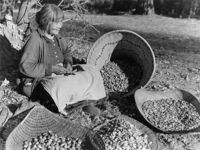 Maggie Howard (Tabuce) preparing acorns
Maggie Howard, also known as Tabuce (1870-1947) seated on ground preparing acorns, surrounded by large baskets of acorns.
-
 Maggie Howard picking up leached acorn dough from leaching basin
-
 Florence Hutchings; about age 12.
Copy Neg: 1981. Loaned by Shirley Sargent for copying.
Florence, who went by Flo, Floy, or Flora, was the daughter of James and Elvira Hutchings, early pioneers in Yosemite's tourist industry. She grew up exploring what would be Yosemite National Park and was often considered a tomboy. She was also close with a number of early influencers of Yosemite National Park, including John Muir. Flo died at age 17 when she was struck by falling debris while hiking up the Ledge Trail to Glacier Point. Park visitors can still visit her grave in the Yosemite Cemetery just east of Yosemite Falls. ("Hutchings Women", NPS.gov)
-
 Woman in Yosemite Park
-
 NPS Individuals, Francis Downs, Supt.'s Secretary.
-
 Lucy Telles next to Gov. Richardson of California at 1926 Indian Field Days, Yosemite Valley. Others unidentified.
-
 Carl Russell on left and Leanna Tom (Agnes Castro's mother) on the right. 2nd best single basket, 2nd prize - $35.00.
-
 Women on horses during Indian Field Days