-
 [Untitled]
-
 Jacob photo for bio
-
 Abigale Mumby Bio Portrait
Portrait for site creator biography
-
 Herb Dittersdorf Portrait for Bio.
-
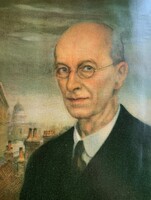 A Transpontine Cockney: Self Portrait by Arthur Rackham (1867-1939)
This is a replication of a self portrait that Arthur Rackham painted of himself using oils on canvas. It is found in the cover page spread of "Arthur Rackham: His Life and Work" by Derek Hudson (1975).
-
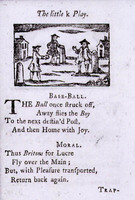 Page from John Newberry's "A Pretty Little Pocket Book."
VOCAB
-
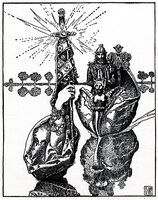 Excalibur and the Sword
This is an illustration by Howard Pyle for the 1903 book "The Story of King Arthur and His Knights". It depicts the sword in the stone.
-
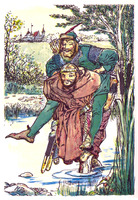 Robin Hood and Friar Tuck
This is a Howard Pyle illustration from the 1883 edition of "The Merry Adventures of Robin Hood".
-
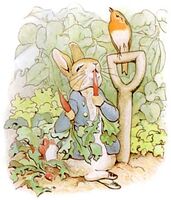 Peter Rabbit
This is an illustration from Beatrix Potter's 1902 book "The Tale of Peter Rabbit". It depicts Peter Rabbit eating Mr McGregor's vegetables.
-
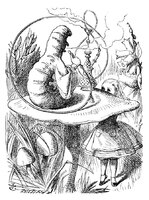 Alice and the Caterpillar
This is a John Tenniel illustration from the 1865 edition of Alice's Adventure in Wonderland. It depicts the Caterpillar and Alice conversing.
-
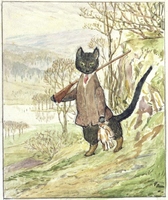 Kitty in Boots
This is an illustration from an early Beatrix Potter book called "Kitty in Boots".
-
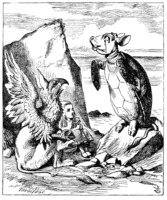 The Gryphon and the Mock Turtle, illustrated by John Tenniel
Illustration of he Gryphon and the Mock Turtle, illustrated by John Tenniel for the first illustrated edition of Lewis Caroll's Alice in Wonderland.
-
 Hercules Assisting Atlas
This illustration was created by Arthur Rackham for the 1922 reprinting of Nathaniel Hawthorne's "Wonder Book" (1851). This illustration depicts Hercules assisting the titan Atlas with holding up the Earth and Sky.
-
 The Three Fates
This illustration was created by Arthur Rackham for the 1922 reprinting of Nathaniel Hawthorne's "Wonder Book" (1851).In this illustration, the three Fates fight over the use of their single shared eyeball.
-
 King Midas
This illustration depicts the mythical King Midas touring his gardens, using his golden touch to turn his roses to gold. This illustration was created by Arthur Rackham for a 1922 reprinting of Nathaniel Hawthorne's "The Wonder Book" (1851).
-
 Rip Van Winkle and townsfolk
This illustration shows an aged Rip Van Winkle talking with townspeople. It is part of Aurthur Rackham's illustrated version of the Washington Irving tale, "Rip Van Winkle."
-
 Young Rip van Winkle
This illustration portrays a young Rip Van Winkle from Arthur Rackham's illustrated edition of the classic Washington Irving story, "Rip van Winkle."
-
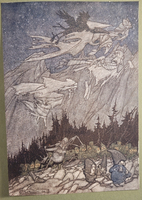 Mysterious Creatures from "Rip van Winkle"
This illustration depicts mysterious creatures from Arthur Rackham's illustrated edition of the classic Washington Irving story, "Rip van Winkle."
-
 Little Pigs in "Mother Goose : The Old Nursery Rhymes”
Illustrations of the Little Pigs nursery rhyme characters beside text. This page was part of the Arthur Rackham's 1913 book "Mother Goose : The Old Nursery Rhymes”.
-
 Mother Goose and Friends in "Mother Goose : The Old Nursery Rhymes”
This is an illustration of Mother Goose being ridden by a witch much to the horror/delight of nearby children. This was created by Arthur Rackham in 1913 for his book "Mother Goose : The Old Nursery Rhymes”.
-
 Rat and Mole
This illustration was created by Arthur Rackham for the 1940 edition of Kenneth Grahame's "The Wind in the Willows" (1908). It depicts Rat and Mole, two characters from the book, meeting in a burrow.
-
 Badger and Mole
An illustration by Arthur Rackham in the 1966 printing of The Wind in the Willows (1908) by Arthur Grahame, depicting two main characters, a badger and a mole, meeting in a burrow.
-
 Mrs. Frog Travelling
This illustration was created by Arthur Rackham (1867- 1939), and depicts Mrs. Frog speaking to a stranger while on a journey. The illustration was completed for the book "The Wind in the Willows" (1908) by Kenneth Grahame.
-
 "Mother Goose" Witch Illustration
This is an illustration of a witch and children done by Arthur Rackham in his 1913 book "“Mother Goose : The Old Nursery Rhymes.”
-
 "In the Queen's Palace" Illustration
This is an illustration done by Arthur Rackham for the 1928 illustrated version of "The Lonesomest Doll" (1901) by Abbie Farwell Brown. It features the words "In the Queen's Palace," and depicts the female main character surrounded by toys.