-
 He leadeth me beside the still waters, Your friend, Elvira Hutchings. Copied from the autograph books of Dorothy & Nellie Atkinson.
Painting by Elvira Hutchings, wife of James Hutchings. The Hutchings owned and operated one of the earliest hotels to welcome and guide tourists through Yosemite. In addition to running the day-to-day operations of the hotel, Elvira studied painting, music, and botany. ("Hutchings," NPS.gov)
-
 Water color in the autograph book of Dorothy & Nellie Atkinson done by Elvira Hutchings. Copied from the autograph book of Dorothy & Nellie Atkinson.
Painting by Elvira Hutchings, wife of James Hutchings. The Hutchings owned and operated one of the earliest hotels to welcome and guide tourists through Yosemite. In addition to running the day-to-day operations of the hotel, Elvira studied painting, music, and botany. ("Hutchings," NPS.gov)
-
 Resolution by the Massachusetts State Federation of Women's Clubs Against the Raker Bill, November 25, 1913; Petitions and Related Documents That Were Presented, Read, or Tabled
With this resolution, the Massachusetts State Federation of Women's Clubs urged Congress to defeat the Raker Bill, a bill to grant San Francisco the right to dam the Hetch Hetchy Valley. In 1913, women's clubs from across the country voiced their desire to protect nature and build a stronger National Park system for the sake of both moral and physical health. The Massachusetts State Federation of Women's Clubs here argued that both women and men found health and inspiration in the beauty of the Valley. Although not using strict preservationist arguments, the Federation stressed that with more hotels and better transportation, the Valley could be enjoyed by more citizens. According to their resolution, San Francisco had no need to dam the Hetch Hetchy Valley and its damming would be an irrevocable sacrifice by the whole nation.
-
 Resolution from the Graffort Club of Portsmouth, New Hampshire Against Granting San Francisco the Hetch Hetchy Valley, February 4, 1910; Committee on the Conservation of Natural Resources; Petitions and Memorials
When Congress first began debating whether to grant San Francisco the Hetch Hetchy Valley in December 1908, women’s clubs provided some of the strongest opposition. Tied to women’s larger effort to extend their traditional “housekeeping” role into the public sector, resolutions like this one from the Graffort Women’s Club of Portsmouth argued that the Hetch Hetchy Valley belonged to all people as a public playground. The General Federation of Women’s Clubs drafted the language for this petition, and dozens of affiliated clubs submitted their own versions.
-
 Petition from the Hypatia Women's Club of San Francisco Supporting Granting San Francisco Water Rights to Lake Eleanor and Hetch Hetchy, February 2, 1910; Committee on the Conservation of Natural Resources Petitions and Memorials
While many women's clubs wrote to Congress asking for the preservation of the Hetch Hetchy Valley, women's club from San Francisco tended to support the idea of building a dam in the Valley. In their petition, the Hypatia Women's Club of San Francisco stressed that the Hetch Hetchy Valley provided the only source of pure and safe drinking water for San Francisco. They questioned the desire of preservationists to sacrifice the needs of people to preserve every tree.
-
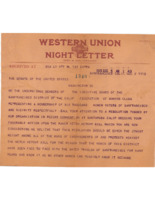 Telegram from the Executive Board of the San Francisco District of the California Federation of Women's Clubs Supporting the Raker Bill, December 2, 1913; Petitions and Related Documents That Were Presented, Read, or Tabled
While most women's clubs who petitioned Congress argued against the damming of the Hetch Hetchy Valley, San Francisco residents stood largely in support of the dam. In their telegram to Congress, the Executive Board of the San Francisco District of the California Women's Clubs urged the Senate to vote for the Raker Bill, a bill to grant San Francisco the right to dam the Valley. Women activists in the Progressive Era often appealed to the special concerns of their gender. In this example, the Federation argued that women faced the water crises daily.
-
 A letter from Fay Fuller to the Editor of Century Magazine
This letter includes a clipping of an article mentioning Fay Fuller's achievement of being the first white woman to make an ascent to the summit of Mt. Rainier. In her letter, she offers the Editor of Century Magazine the opportunity to have her write an article and include images she took while on her climb.
-
 Melody Webb Grauman walking in Lake Clark National Park.
NPS Historian Melody Webb Grauman walks along the shore of a lake in Lake Clark National Park during a visit to homesteaders at the remote site.
-
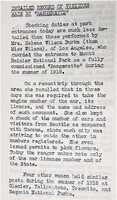 Article from the August 1937 "Park Service Bulletin" newsletter thought to be one the earliest use of the term "rangerette" for women rangers within the NPS
-
 Minerva Hamilton Hoyt Brochure
This brochure was created by Joshua Tree National Park to spotlight Minerva Hamilton Hoyt (1866-1945). She was a devoted advocate for the protection of deserts, and helped foudn the International Desert League. Her tireless desert conservation efforts led to the establishment of Joshua Tree National Park.
-
 Melody Webb Grauman and local residents in Lake Clark.
NPS Historian Melody Webb Grauman speaks with a local settler and her child in Lake Clark National Park.
-
 Melody Webb Grauman in Lake Clark.
Melody Webb Grauman, NPS historian, is shown feeding Canada jays in front of Proenneke Cabin in Twin Lakes, Alaska in Lake Clark National Park and Preserve.