-
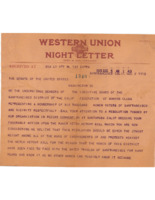 Telegram from the Executive Board of the San Francisco District of the California Federation of Women's Clubs Supporting the Raker Bill, December 2, 1913; Petitions and Related Documents That Were Presented, Read, or Tabled
 While most women's clubs who petitioned Congress argued against the damming of the Hetch Hetchy Valley, San Francisco residents stood largely in support of the dam. In their telegram to Congress, the Executive Board of the San Francisco District of the California Women's Clubs urged the Senate to vote for the Raker Bill, a bill to grant San Francisco the right to dam the Valley. Women activists in the Progressive Era often appealed to the special concerns of their gender. In this example, the Federation argued that women faced the water crises daily.
-
 A letter from Fay Fuller to the Editor of Century Magazine
 This letter includes a clipping of an article mentioning Fay Fuller's achievement of being the first white woman to make an ascent to the summit of Mt. Rainier. In her letter, she offers the Editor of Century Magazine the opportunity to have her write an article and include images she took while on her climb.
-
 Melody Webb Grauman walking in Lake Clark National Park.
 NPS Historian Melody Webb Grauman walks along the shore of a lake in Lake Clark National Park during a visit to homesteaders at the remote site.
-
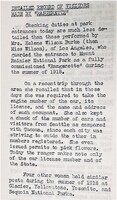 Article from the August 1937 "Park Service Bulletin" newsletter thought to be one the earliest use of the term "rangerette" for women rangers within the NPS
-
 Minerva Hamilton Hoyt Brochure
 This brochure was created by Joshua Tree National Park to spotlight Minerva Hamilton Hoyt (1866-1945). She was a devoted advocate for the protection of deserts, and helped foudn the International Desert League. Her tireless desert conservation efforts led to the establishment of Joshua Tree National Park.
-
 Spectre: Issue 6
 This is the 6th issue of the Spectre newsletters, published by the Spectre Collective of Revolutionary Separatist White Women in Ann Arbor, Michigan. Spectre was a separatist, queer, feminist publication from the 1970s. This issue features articles about ageism, classism, rape, etc., as well as letters from readers to the publisher. There are hand-written comments on this issue that act as a headings/subheadings and, in come cases, general commentary about the contents.
-
 Melody Webb Grauman and local residents in Lake Clark.
 NPS Historian Melody Webb Grauman speaks with a local settler and her child in Lake Clark National Park.
-
 Melody Webb Grauman in Lake Clark.
 Melody Webb Grauman, NPS historian, is shown feeding Canada jays in front of Proenneke Cabin in Twin Lakes, Alaska in Lake Clark National Park and Preserve.
-
 Lavender Woman
 Lavender Woman began as a recurring column in the feminist publication, The Feminist Voice, written by members of the Women's Caucus of Chicago Gay Alliance. By November 1971, Lavender Woman became an independent publication. The first issues began with only a few hundred copies, which eventually increased to a press run of 2,000 copies that consistently sold out.
In the first issue of Lavender Woman, the founders expressed what they hoped the newspaper might contribute to the lesbian community in Chicago and beyond: "We, of the Lavender Woman, feel that this newspaper, written by and for Lesbians, is a powerful weapon against the society that tries, in vain, to keep us closeted and out of sight." They believed the newspaper would help to nurture the growth of the Lesbian community and increase its political consciousness, offering a space for lesbians to share their experiences, gifts, and knowledge with one another. Different women contributed to each issue, listing their names on the second page of each issue. This was an effort to include many different lesbian voices and lesbian works in the magazine. Lavender Woman referred to these submissions as "bits of themselves" affirming that the art, writing, photos, etc., being shared were personal to those who chose to share their experiences.
Unlike some lesbian and feminist publications that operated out of universities and larger organizations, Lavender Woman never had an official office. Women met at each other’s apartments, where layout and paste-up happened on the living room floor, the kitchen table, or any available surface. Any lesbian who showed up to a meeting was welcome to participate as much or as little as she wished.
In 1973, the Chicago Lesbian Liberation group split from Lavender Woman and began publishing its own newsletters, including two issues of The Original Lavender Woman in September and October 1974. This was one of the first significant divisions in the lesbian periodical publishing community.
-
 Lavender Woman: Volume 5, Number 1
 This is the final issue of the lesbian feminist newspaper Lavendar Woman. Publications of Lavendar Woman typically included articles on lesbian and feminist issues, illustrations, interviews, news, and poems, with a particular focus on arts and culture. This issue contains articles about women and lesbians in the arts, poetry and fictional writing, information about other feminist lesbian periodicals, and news coverage of a recent presentation held in New York City and sponsored by the International Tribunal on Crimes Against Women. Interestingly, the creators of this issue explain their reasons for discontinuing the publication, stating "it's time to face the fact that we're dying" (p. 1). They explain the lack of staff, time, and energy required to continue to produce the newspaper, and describe being "out of touch" with the lesbian feminist identity and movement.
-
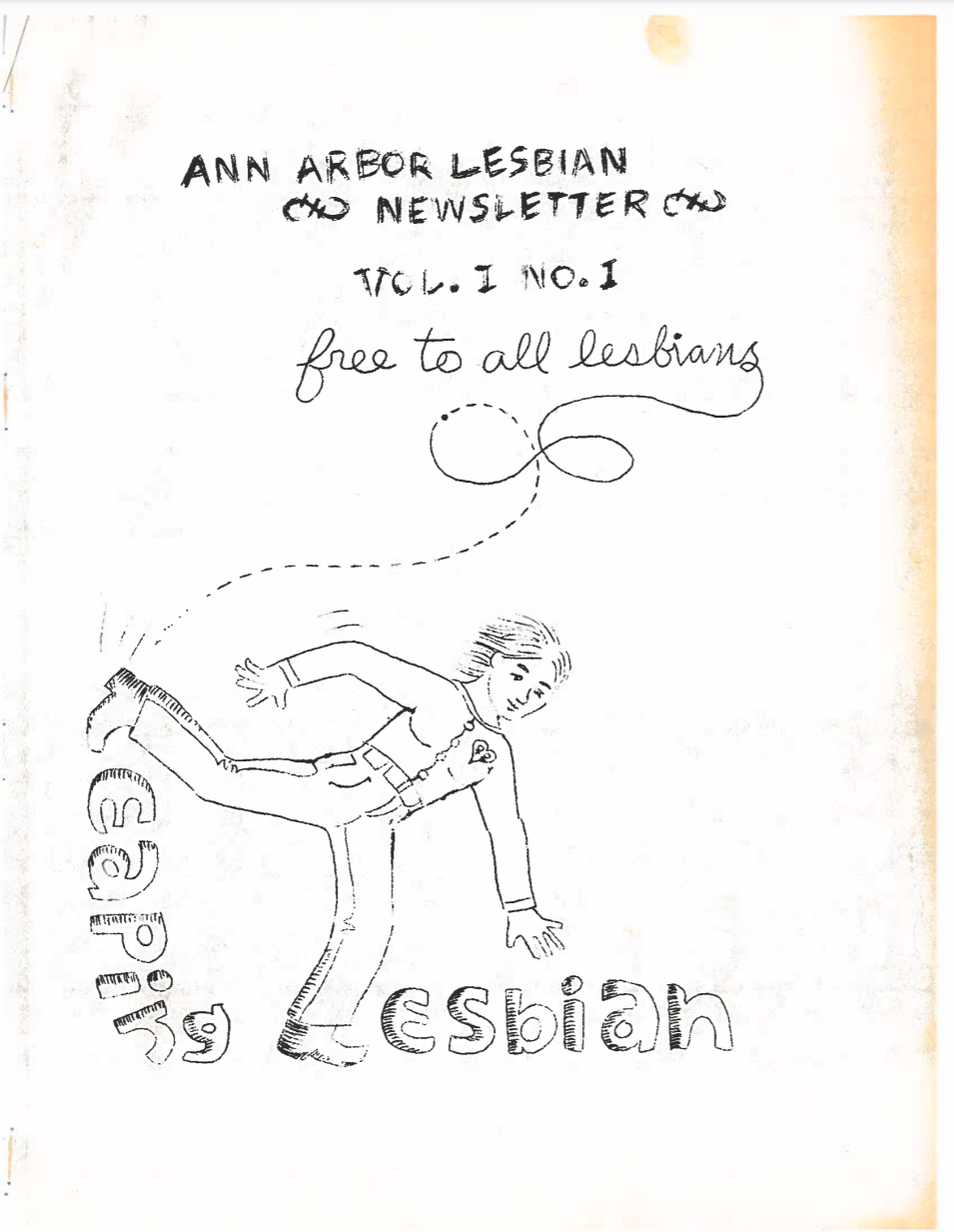 The Leaping Lesbian
 Paraphrased from the University of Michigan Special Collections Finding Aid:
The creative and publishing force behind the Leaping Lesbian publication was formed in December of 1976 in Ann Arbor, Michigan. This collective of four Ann Arbor women (Laura Sky Brown, Susan Fecteau, Nancy Silverrod, and Perry Silverschanz), funded by the University of Michigan Student Government, published their first newsletter early in 1977.
Initially a free publication with a small monthly circulation, the Leaping Lesbian sought to fill the needs of the Ann Arbor lesbian community. In order to achieve this objective, the collective accepted and published original material from its readers, which included poetry, articles, essays and letters. Topics of submitted and published materials varied, ranging from social, political and legal issues to emotional and erotic issues. Articles covered prostitution, lesbian child custody battles, gay violence, eating disorders, lesbian performers and lesbian profiles.
Within two years, it had grown from a small, monthly newsletter with a mainly local readership to a larger, bimonthly magazine maintaining a national lesbian following. In order to keep up with the growing demands, the collective asked all readers to subscribe to the magazine. The May-June 1978 issue (Vol. 2, #4) marked the last free issue of the Leaping Lesbian . Although the growth of the Leaping Lesbian reflected its success, the collective records, particularly the meeting minutes, show that the operation of the publication did not always run smoothly. Early in the collective's history, personality conflicts, heavy workloads and strained budgets added tension to its operation. Although it is not clear why the collective disbanded, or never reformed, the March 1980 (Vol. 3 #5) issue was the last Leaping Lesbian ever to be published.
-
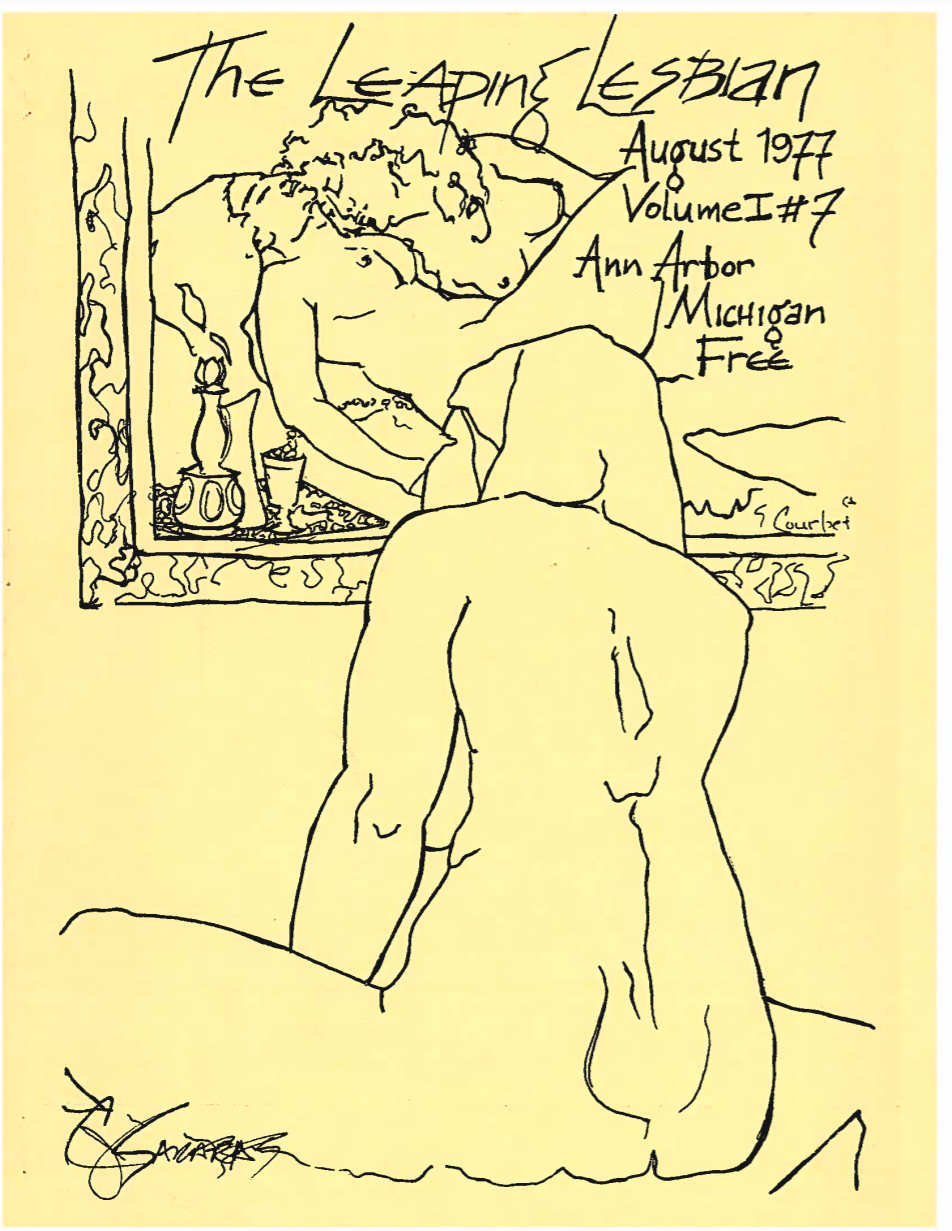 The Leaping Lesbian: Volume I, #7
 The Leaping Lesbian sought to fill the needs of the Ann Arbor lesbian community. This issue contains reflections on the second annual Michigan Womyn's Music Festival and the fourth annual National Women's Music Festival. Also included is an article written by the feminist collective behind Womanspace, a local Ann Arbor bookstore with a women-only policy, an interview with a local lesbian struggling for child custody, instructions for a wiccan spell to pass the Equal Rights Amendment, and an ad for the local lesbian-feminist record label Olivia Records.
-
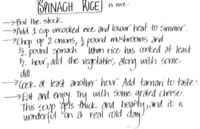 Spinach Rice is nice
 Spinach Rice is nice
Boil the stock
Add 1 cup uncooked rice and lower heat to simmer
Chop up 2 onions, 1/2 pound mushrooms and 1/2 pound spinach. When rice has cooked at least 1/2 hour, add the vegetables, along with some dill.
Cook at least another hour. Add tamari to taste.
Eat and enjoy. Try with some grated cheese. This soup gets thick and hearty, and it is wonderful on a real cold day.
-
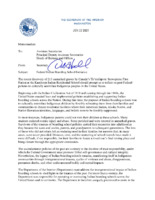 Memo on Federal Indian Boarding School Initiative
 A memo from the United States Department of Interior outlining the Indian Boarding School Initiative. This initiative intends to inspect former Indian Boarding School sites for possible burial sites. It is signed by Deborah Hall, the first Native American U.S. Secretary of the Interior.
-
 Wičhówoyake - Story
 Wičhówoyake is the Dakota word for 'story.' Thank you to Heȟáka Akichita for his translation. A female Park Service employee reads to a crowd that is primarily children.
-
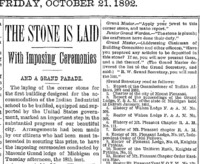 The Stone is Laid
 Newspaper clipping from Isabella County Enterprise announcing and celebrating the first stone being laid for the construction of the Mt. Pleasant Boarding School
-
 Saginaw Chippewa Honoring, Healing & Remembering 2021
 A 2021 press release from the Saginaw Chippewa tribe about moving forward in a healing way.
-
 Sault Ste. Marie Chippewa Memorial Walk Poster
 A poster detailing a walk on August 20, 2021 commemorating the victims and survivors of the boarding schools.
-
 Corn Hole -- Ladies' Hour, Hot Springs National Park.
 Women in dresses soak their feet in a hot spring.
-
 Childhood is Sacred
 A promotional video for the LAUNCH initiative by the Inter-tribal Council of Michigan. Details on the project goals and resources can be found at www.itcmi.org/launch.
-
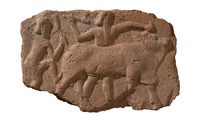 Gilgamesh and Enkidu fighting the Bull of Heaven?
-
 Ain't I A Woman?
 Described as “a Midwest newspaper of women’s liberation,” Ain’t I a Woman? (AIAW?) began in 1970 as a project of a closed collective of the Iowa City Women’s Liberation Front. In the first issue of AIAW?, the collective explains their reasoning and goals behind the publication, explaining that "until now there have been no underground or peoples papers in Iowa City," only "the usual commercial town paper and the University paper"--neither of which could be trusted sources of salient information, "being written for the people not by the people." The collective expressed the need for women to publish their own paper outside of the mainstream media, which they described as being controlled by capitalist interests and riddled with "unmitigated sexism." Uniquely, the founders of Ain't I A Woman? rejected a hierarchical organization of roles (such as editor, assistants, and staff) in favor of a collective decision-making model for the paper's creation and publication, and claimed to maintain no "professional standards."
AIAW? also aimed to increase much-needed communication between women in the Midwest, particularly between lesbians and radical women who did not benefit from the community and resources of large urban areas: "Unlike our sisters in Chicago or Detroit, who have large brown and black populations and proportionately large working class populations, most of us [in Iowa City and in smaller Midwest cities] tend to work in groups that are campus rather than community based," limiting their ability to pursue a radical feminist agenda. Although based in Iowa City, AIAW's scope encompassed the entire Midwest region, in terms of both readership and contributions to the publication.
While at first, lesbians composed a minority of the AIAW?, by fall 1971 the collective became “almost all gay" due to turn over in the collective's membership as well as existing members “realizing they were gay or choosing against their heterosexual relationships" (“Finding Direction,” Ain’t I a Woman?, Oct. 15, 1971, 2). Although content dedicated to sexuality and the lesbian movement had been a part of the publication from the start, this marked a shift in the collective's stated intentions for the publication going forward.
Issues of AIAW? typically included poetry, illustrations, 'letters to the editor,' ads for feminist lesbian businesses and organizations, and lengthy articles on feminist theory, lesbian issues, and radical politics.
-
 Zingerman's Magic Brownies
 Black Magic Brownies
Chopped unsweetened chocolate 1 cup plus 1 Tbsp 195 g
Unsalted butter ¾ cup plus 2 Tbsp 195 g
Pastry flour 1 ½ cups 218 g
Baking powder 1 tsp
Large eggs 4
Granulated sugar 2 ¾ cups 540 g
Sea salt 1 tsp
Vanilla extract 2 tsp
Magic Brownies
Walnut pieces 1 ¼ cups 150 g
Buenos Aires Brownies
Dulce de leche 3 cups plus 6 Tbsp 546 g
Demerara sugar for sprinkling top
Sea salt for sprinkling top (optional)
1. Preheat the oven to 350 degrees F[180 degrees C]. Spray a 9-by-13-in [23-by-33-cm] pan with nonstick cooking spray.
2. In a double boiler, melt the chocolate and butter. Set aside.
3. In a medium bowl, combine the pastry flour and baking powder. Mix with a whisk to eliminate any lumps of flour and to distribute the baking powder evenly.
4. In a large mixing bowl, combine the eggs, sugar, salt, and vanilla. Beat with a whisk until well combined and aerated, about 5 minutes. If you are using a stand mixer, use the whisk attachment on medium speed for this step. Add the melted chocolate/butter mixture to the egg mixture and whisk to combine evenly. Stir in the dry ingredients, using a rubber spatula. If using a stand mixer, use the paddle attachment for this step and mix on a low speed.
5. If you are making Black Magic Brownies, you are done mixing and can move on to step 6. If you are making Magic Brownies, toast the walnuts. Place the walnuts on a sheet tray in a 325 degree F [165 degree C] oven for 10 to 15 minutes, or until they’re a deep golden brown. Let cool. Add the toasted walnuts to the batter and mix gently simply to distribute them evenly, then go to step 6. For Buenos Aires Brownies, see the directions that follow.
6. Pour the batter into the prepared pan. Carefully spread it to the corners of the pan in an even layer. Bake for 40 to 45 minutes, or until a toothpick inserted in the center is clean.
7. Remove from the oven and cool on a cooling rack for at least an hour. Cut into 12 squares, using a sharp knife to avoid crushing the top. Chilling the brownies before cutting may help the squares look more beautiful, but they taste better at room temperature.
Buenos Aires Brownies
1. Warm the dulce de leche slightly, on the stove or in a microwave. This will make it more spreadable. Place two-thirds of the brownie batter in the pan and spread evenly to cover the bottom. Spread the dulce de leche out evenly over this layer of batter. Top with the remaining brownie batter and spread to cover the dulce de leche. Sprinkle the top with Demerara sugar. If you like sweet and salty desserts, also sprinkle with a little sea salt.
-
 Ain't I A Woman?: Volume III, Number 4
 This June 1973 issue of Ain't I A Woman?--described on page 1 as a "publication reflecting the opinion of...a small collective of radical gay women" in Iowa City--contains material related to the feminist self-defense movement, childcare and motherhood, violence against women, and anti-capitalism. Also included is Jane Alpert's Mother Right: A New Feminist Theory, a manifesto which Alpert originally mailed to Ms. Magazine, denouncing "the sexual oppression of the left" and detailing her conversion from militant leftist to radical feminist.
-
[Untitled]