-
 Holy Childhood School of Jesus
A drawing of the Holy Childhood School of Jesus in Harbor Springs, Michigan.
-
 Grand Rapids Vigil
An image of a vigil held in Grand Rapids to honor the memories of the dead children found in Kamloops, BC.
-
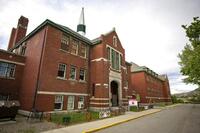 Kamloops Indian Residential School
The location at which the remains of 215 Indigenous children were found in 2021.
-
 Former Old St. Joseph Orphanage and School
An image of the demolished remains of the Old St. Joseph Orphanage and School
-
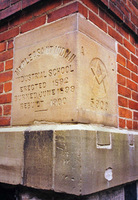 Mt. Pleasant Indian Industrial Boarding School
A picture of a plaque on the side of the Mt. Pleasant Indian Industrial Boarding School
-
 "Trail of Tears" by Max D. Standley
-
 Bishop Frederic Baraga
, known as the Snow Shoe Priest, holding his dictionary of the Ojibwe language, which was the first attempt to render into English the Ojibwe language.
-
 Portrait of President Andrew Jackson
A portrait of President Andrew Jackson by Ralph Eleaser Whiteside Earl
-
 Indian Removal Act
An image of the Indian Removal Act enacted by the 21st United States Congress.
-
 Mt. Pleasant School for Indians
Pamphlet about the Mt Pleasant Indian School.
"This pamphlet was executed by student-apprentices of the printing trade at the Chilocco Indian School, Oklahoma"--P. [17].
Note: To protect the privacy of those that died as well as the survivors, any pages with images of students has been removed from this file. The original pamphlet was 20 pages long. The full version can be found at the Clarke Historical Library at Central Michigan University.
-
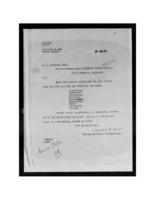 Mt. Pleasant Indian School Annual Reports 1910-1913
Annual reports written by the Superintendent of the Mt Pleasant Indian School addressed to the the Commissioner of Indian Affairs. Each report provide details on the number of students in attendance, health conditions, building conditions, curriculum and more.
This PDF in an excerpt from the original 1,174 page PDF.
-
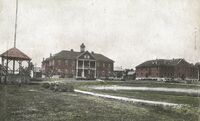 Mt. Pleasant Boarding School (Historical)
A picture of the Mt. Pleasant Boarding School, circa 1907
-
 Annual Naming Ceremony Invitation
Image in the state of Michigan with major highways leading to Harbor Springs, the location of the annual naming ceremony
-
 "Honorary Chiefs"
An example of cultural appropriation commonly committed during the 1950s. A photo of members of the Michigan Indian Foundations, Inc. wearing ceremonial headdresses at an event.
-
 Warren Petoskey Essay Excerpt
Biographical information from the Warren Petoskey Papers Collection. This is the first page, accounting for his experience growing up in rural Michigan, dealing with racism and parental abuse. Petoskey connects the abuse with his father's and grandfather's attendance at Indian Boarding Schools.
-
 Holy Childhood Postcard
A postcard depicting the Holy Childhood Boarding School. Contains handwritten text over the image read as: "I will have this bldg. completed Feb. 1-1927 then I'll go to erect another school at Petoskey, Michigan." Also contains printed text at the bottom of the postcard read as: "Holy Childhood School, Harbor Springs, Mich. Conducted by the School Sisters of Notre Dame."
-
 Indian Land Cessions and Reservations
A map of land cessions and reservations in Michigan. Each section of the map represents the land that was ceded with each treaty.
-
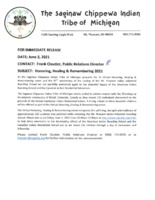 Memo titled Honoring, Healing, and Remembering 2021
A public memo from the Saginaw Chippewa Indian Tribe of Michigan showing unity to the Tk’emlúps te Secwépemc community after the recent discovery of 215 graves on the grounds of a former boarding school.
The memo also invites the public to the Honoring, Healing & Remembering an event to honor the 225 lives lost to the Mt. Pleasant Industrial Indian Boarding School
-
 Pamphlet from the Ziibiwing Center of Anishinabe Culture & Lifeways
A pamphlet detailing the mission of the Ziibiwing Center and their collection. Contact information, location, and hours are listed.
-
 History of Holy Childhood Article
Two page article on the history of the Holy Childhood Indian Boarding School in the 1949 - 1950 Annual Review of the Michigan Indian Foundation, Inc. The foundation was a private organization of wealthy Michiganders who raised money for the Holy Childhood school.
-
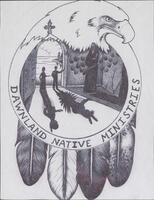 Dawnland Ministries logo
Logo for the church started by Warren Petoskey, Dawnland Native Ministries. Image has the shape of a dream catcher, with four feathers hanging from the bottom and an eagle head on top. Inside the dreamcatcher is a image of two children entering into a boarding school. The children are wearing simple, western clothing. The sun is behind the children and their shadows are depicted wearing native ceremonial clothing. There is a nun in the shadow of the entrace, she appears to be waiting for the children to enter. The wall of the room has large cracks starting from the foundation of the building.
-
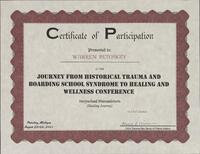 Certificate of Participation
A certification of participation presented to Warren Petoskey for his participation in the Journey from Historical Trauma and Boarding School Syndrome to Healing and Wellness Conference. Written below the title of the conference is "Noojmohaad Bbamaadiziwin (Healing Journey)." The item is dated August 22 - 26, 2001 and is signed by a representative of the Little Traverse Bay Bands of Odawa Indians.
-
 Bishop Baraga Shrine
A photograph of part of the shrine to Bishop Baraga, who helped establish the Old St. Joseph Orphanage and School. Part of the Bishop Baraga Shrine Historical Site located in Baraga County.
-
 Bishop Baraga Shrine Historical Site Sign
A photograph of a sign to welcome visitors for the Bishop Baraga Shrine Historical Site located in Baraga county, the area of the former Old St. Joseph Orphanage and School. The site includes the shrine and a missionary center.
-
 Johnson & Graham's Lessee v. McIntosh, 21 U.S. 543 (1823)
Land transfers from Native Americans to private individuals are void. When a tract of land has been acquired through conquest, and the property of most people who live there arise from the conquest, the people who have been conquered have a right to live on the land but cannot transfer title to the land.
Facts
This action for ejectment was based on a land dispute after Thomas Johnson, a Supreme Court Justice, bought land from Native Americans in the Piankeshaw tribe. His descendants inherited the land after Johnson's death and leased it to individuals who brought the action against William M'Intosh. The federal government had given M'Intosh a land patent to allegedly the same land, although in reality it appears that the properties were actually separate. The parties thus brought this litigation in order to obtain a judgment on priority rights to property more generally.
Ruling that the Native American tribe did not have the right to convey the land, the federal district court held that Johnson's initial purchase and the chain of title stemming from it were invalid.
Note: Marshall's reliance on international law as basis for discovery doctrine.
Opinions
Majority
John Marshall
Bushrod Washington
Henry Brockholst Livingston
William Johnson, Jr.
Thomas Todd
Gabriel Duvall
Joseph Story
In an unanimous opinion, Marshall used historical analysis to find that only the government, rather than the Native American tribes, held title to the the land. He argued that the patterns of discovery during the European colonization of the New World meant that each European nation gained sovereignty (and also title) over the land that it discovered. This trumped the right of occupancy of the Native American tribes, at least with regard to the specific colonizing power. In the situation of the U.S., this right belonged to the British when they first acquired colonies. The federal government then inherited the right from Great Britain after the American Revolution. Native Americans cannot sell their land except to the federal government.
Case Commentary
This case created a distinction between the right of occupancy and the right of ownership that persists in U.S. jurisprudence concerning Native American lands. Economists have pointed out that limiting the right to purchase Native American land to the federal government allows it to be sold at the lowest possible prices because there is no competition. The patronizing tone of the opinion has fallen into disfavor as Native Americans have come to receive more sympathy from the legal academy, but its holding remains valid.
* Annotation taken from Justia.com