-
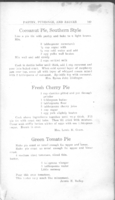 Fresh Cherry Pie
 Fresh Cherry Pie
1 cup cherries pitted and put through
grinder
1 tablespoon butter
2 tablespoons flour
3 tablespoons cherry juice
1 cup sugar
1 egg yolk slightly beaten
Cook above ingredients together until very thick. Fill
pie tin with crust and bake. Then fill crust with mixture.
Cover with stiffly beaten whites of eggs with one tablespoon
Sugar. Brown in oven.
Mrs. Lewis M. Gram.
-
 Kreplach
 A Jewish mother was much distressed over the problem of her young son who was afraid to eat the popular dish known as kreplach. She took the boy to a psychiatrist for consultation. After hearing the case, the doctor said, "Now, Madam, this is very simple. Take the boy home, take him out into the kitchen, and show him how kreplach are made. This should probably eliminate the condition."
Hopefully the mother followed his advice. On the kitchen table she put out a small square of dough beside which was a small mound of prepared chopped meat. "Now," she said, "there is nothing here you should mind." The lad beamed and nodded encouragingly. The mother then put the meat in the center of the dough and folded over one corner. The boy smiled and all seemed to be going well. She folded over the second corner and the third. The boy was nodding, and the experiment seemed to be progressing most favorably. Then she folded over the fourth and final corner; whereupon the boy groaned and muttered ........
"Oi, KREPLACH!"
What the psychiatrist didn't know was to tell her to try one of our recipes for kreplach. They're guaranteed to not only remove all phobias, but to nurture a life long affection for the luscious dish as well!
Kreplach I
Bessie Ginsburg
1 cup flour
1 or 2 small eggs
½ t. salt
Mix together. Knead until elastic using a floured board. Add flour until smooth and elastic and dough does not stick. Roll out on floured table and cut into 2-2 ½ inch squares. Filling: Grind meat, beef or turkey that has been cooked. To ½ cup meat, add 1 egg and some browned onion and season. Place 1 t. Filling in each square. Dampen edges with water and fold over to seal in a triangle. Boil in salted boiling water 10 minutes Usinig [sic] a wooden spoon, stir to prevent sticking. Drain in a colander and rinse in cold water. Serve in chicken soup or roast in oven, or heat in oven with salt and chicken fat.
Makes 2 dozen.
Kreplach II
Naomi Lansky
Dough:
1 egg
Approx. ⅔ C. flour
¼ t. salt
Filling:
Any cooked meat or leftover (⅓ lb. meat is sufficient)
½ t. onion juice
Finely chopped celery
Schmaltz to hold meat together
Salt and pepper to taste
To make dough, beat egg slightly. Add salt and enough flour to make a stiff dough. Knead well on floured board. Invert bowl over dough and let stand, covered, ½ hr. Roll out as thin as possible. Dough should not be sticky but not too brittle. Cut dough into squares. Fill and pinch ends together. Cook in boiling salted water for 15 minutes. Drain
To make filling, grind meat very fine, add other ingredients, season to taste, and mix well.
-
 Concord Grape Wine I & II
 Wine has played an important role in Jewish ceremony and culture throughout the ages. In biblical times the use of wine was obligatory both in public religious functions and for domestic ceremonial occasions. The references to wine as a means of promoting joy, as a sign of the bountiful gifts of providence, and as a token of personal gratitude to the creator are numerous throughout the Bible.
How highly wine is regarded in the Bible may be seen from the fact that in a figurative sense Israel is called a vine. Later the rabbis used wine as a metaphor not only to represent Israel but also the Torah, the Messiah, and holy men. In the Talmud it is stated that in the world to come the righteous will drink wine from the grapes grown during the days of creation. The greatest blessing in the conception of the Hebrew people, the blessing of peace, is represented by the picture of a man resting under his vine and fig tree. Abundance of wine is in the Bible an indication of prosperity, and to offer bread and wine to a guest is a sign of friendship and hospitality.
The rabbis held that taken in moderation wine is not only a healthful stimulant but is possessed of great curative properties, the best of all medicines. However, drunkeness was strictly forbidden. It was the custom in Talmudic times to give ten cups of wine to mourners with the "meal of consolation".
The use of wine has been continued at religious functions in the synagogue and in the Jewish home on all festive occasions to this very day.
Concord Grape Wine I
10 lbs. ripe grapes, stemmed
5 lbs. sugar
Put grapes in an open crock and squeeze or mash by using 2 smooth boards. Cover crock with muslin and let stand at room temperature for 1 week. Stir once or twice during that period. Strain through muslin. Do not squeeze the mashed grapes while straining. Return the wine to the crock and add the sugar, dissolved with some of the grape juice. Cover with muslin and let stand 7 days longer at room temperature. Fill bottles with wine, but do not cork tightly. Store in a cool place away from light for 1 month. Taste and add more dissolved sugar if desired. Will be ready for use in 3 months. Matures and increases in strength after that initial period.
Yield: approximately 2-2 1/2 gallons
Concord Grape Wine II
10 lbs. ripe grapes, stemmed
3 qts. boiling water
5 lbs. sugar
Put grapes in crock and pour in boiling water. When cool enough to handle, squeeze with hands without crushing seeds. The grapes need to be mashed to a dry pulp. Cover with muslin and let stand 3 days. Strain through muslin, squeezing lightly. Add sugar and stir. Cover and let stand 1 week. Uncover and skim carefully. Lay bottle on side and store in a cool place away from light. Ready for use in 2-3 months.
Yield: about 2 gallons
-
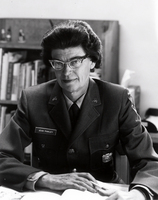 Portrait Photo of Jean Pinkley
 Portrait photo of Jean Pinkley at her desk in uniform..
-
 Jean Pinkley at Cliff Palace in Mesa Verde National Park
 Jean Pinkley, an archaeologist at Mesa Verde National Park, with officials of the National Geographic Society, Smithsonian Institute, and the National Park Service in the Cliff Palace, the largest of the cliff dwellings.
-
 Portrait Photo of Estella Leopold
 A portrait photo of Aldo Leopold's youngest daughter, Estella. Shack is behind her.
-
 Zion National Park Employee at Desk
 A color photo of a female NPS employee in uniform as she sits at a desk with toy cars on the desk and equipment in the background.
-
 Color Photos of Visitors at Lava Point Overlook
 A color photo of a young woman smiling near Lava Point Overlook at Zion National Park
-
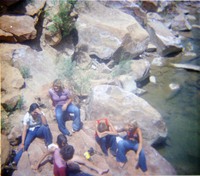 Women and men seated on rocks next to river at Zion National Park
 A colored photo of six young men and women sitting on rocks near the river at Zion National Park.
-
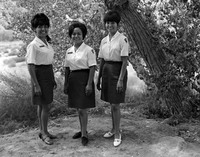 Three Navajo women who worked at the South Entrance Station of Zion National Park
 Black and white photo of three Navajo women in uniform standing in a line in front of a tree.
-
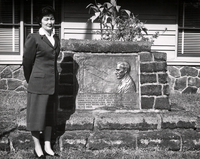 Mitsuko T. Shikuma stands in front of a sign in Hawai'i Volcanoes National Park.
 NPS employee Mitsuko T. Shikuma stands next to a plaque showing Stephen Mather, first director of the National Park Service. Mrs. Shikuma was an "information-receptionist" at Hawai'i National Park.
-
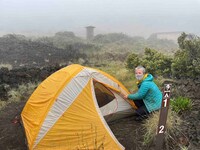 Camper setting up for bad weather in Haleakalā National Park.
 A backpacker wearing a face mask sets up camp in bad weather at a backcountry campsite in Haleakalā National Park on Maui.
-
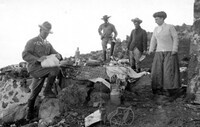 A woman serves lunch at Haleakalā Crater Rim.
 An unnamed woman assists in serving lunch to three men at a resthouse on the rim of Haleakalā Crater in Hawaii, seven years before the establishment of Hawai'i National Park Haleakalā Section in 1916. Haleakalā became an independent park in 1961.
-
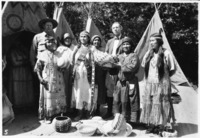 Indian Field Days
 Content Note: Indian Field Days, while an important place for basket weavers like Tabuce Howard to sell and market their work, were a series of events that subjected local indigenous populations to discrimination and stereotyping. Native peoples in the area were paid to wear costumes belonging to Plains Indians and stand by fabricated "wig wams" for the benefit of white tourists. Because of the often untruthful depictions of local indigenous peoples in the images from these events, we have largely left them out of our archive. This image is the exception as it does present an important role in the lives of female basket weavers like Tabuce Howard, Lucy Telles, and Carrie Bethel.
-
 Basket by Tabuce Howard
 Coiled. Willow, sedgeroot, redbud, bracken fern root. H 17, Dia 36 cm
Yosemite National Park, YOSE 66801
-
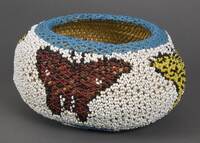 Basket by Tabuce Howard
 Unlike other weavers who created their patterns by counting out beads as they wove, Maggie Howard would sometimes bead directly onto a pattern to avoid having to count beads. Maggie stitched the pattern to this basket and then beaded over it.
Coiled. Glass seed bead, willow, paper, thread. H 9, Dia. 16.2 cm
Yosemite National Park, YOSE 7223
-
 Basket by Tabuce Howard
 This basket is one of several Maggie Howard made incorporating her Paiute name "Tabuce" as the pattern.
Coiled. Willow, bracken fern root, redbud. H 7.5, Dia 15.2 cm
Yosemite National Park, YOSE 7863
-
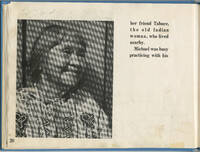 Michael and Anne in the Yosemite Valley
 Children's book describing Michael Adams and Anne Adams Helms adventures in the High Sierras illustrated with photographs by Ansel Adams. Story follows the daily life and customs of brother and sister living in the Yosemite Valley exploring nature, visiting with Maggie ""Tabuce"" Howard (a major basket demonstrator and member of the Mono Lake Paiute tribe), and spending time with their Uncle Don.
-
 Maggie Howard--Mono Lake Paiute--ca 1930's at Yosemite
 Yosemite Maggie Howard--Mono Lake Paiute--ca 1930's at Yosemite Photograph Notes: Maggie Howard--Ta-bu-ce--Mono Lake Paiute--ca 1930's--Yosemite Valley Indian Day Indian Photograph Source
-
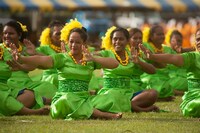 Samoan villagers perform a traditional dance in the National Park of American Samoa.
 Samoan villagers perform as part of a cultural demonstration in the National Park of American Samoa.
-
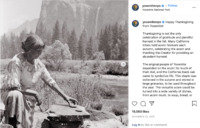 A Thanksgiving Instagram post featuring Maggie Tabuce Howard
 Caption reads:
"Happy Thanksgiving from Yosemite!
Thanksgiving is not the only celebration of gratitude and plentiful harvest in the fall. Many California tribes hold acorn festivals each autumn, celebrating the acorn and thanking the Creator for providing an abundant harvest.
The original people of Yosemite depended on the acorn for much of their diet, and the California black oak came to symbolize life. This staple was collected in the autumn and stored in large granaries, to be used throughout the year. The versatile acorn could be turned into a wide variety of dishes, from acorn mush, to soup, bread, or cakes.
Tabuce (“Maggie”) Howard (1870-1947) was a Paiute woman who was born at Mono Lake but moved to Yosemite Valley at a young age. At first, she made her livelihood working in park hotels, and later by making baskets to sell to tourists. Most importantly, she also gave public presentations where she demonstrated traditional crafts and cooking techniques. Photos show her processing and pounding acorns, then cooking acorn cakes on a heated stone.
November is National Native American Heritage Month, and Yosemite is the ancestral home of seven traditionally associated tribes: the American Indian Council of Mariposa County, Inc. (aka Southern Sierra Miwuk Nation), Bishop Paiute Tribe, Bridgeport Indian Colony, Mono Lake Kutzadikaa, North Fork Rancheria of Mono Indians of California, Picayune Rancheria of the Chukchansi Indians, and the Tuolumne Band of Me-Wuk Indians. Learn more about Yosemite's original people on the park website (link in our profile.) #NAHeritage #Yosemite #nationalpark"
-
 Bread From Acorns
 A video of Maggie Tabuce Howard demonstrating how Native Americans used acorns to make bread.
-
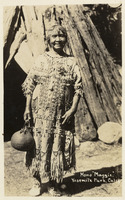 Mono "Maggie", Yosemite Park, Calif.
 View of the Paiute woman Tabuce, also known as Maggie Howard, in Yosemite in native dress. A bark house is seen behind her.
-
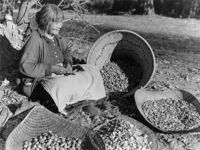 Maggie Howard (Tabuce) preparing acorns
 Maggie Howard, also known as Tabuce (1870-1947) seated on ground preparing acorns, surrounded by large baskets of acorns.
-
 Maggie Howard picking up leached acorn dough from leaching basin